Showing posts with label subject: death/grief. Show all posts

Sunday, April 22, 2012

Liar by Justine Larbalestier

Title: Liar
Author: Justine Larbalestier
Publisher: Bloomsbury USA Children's Books
Release Date: September 29, 2009
Pages: 376 pages (hardcover)
How I Got the Book: From the school library.
Purchase: Amazon; Barnes & Noble; Book Depository

Micah will freely admit that she’s a compulsive liar, but that may be the one honest thing she’ll ever tell you. Over the years she’s duped her classmates, her teachers, and even her parents, and she’s always managed to stay one step ahead of her lies. That is, until her boyfriend dies under brutal circumstances and her dishonesty begins to catch up with her. But is it possible to tell the truth when lying comes as naturally as breathing? 

Taking readers deep into the psyche of a young woman who will say just about anything to convince them—and herself—that she’s finally come clean, Liar is a bone-chilling thriller that will have readers see-sawing between truths and lies right up to the end. Honestly.

Review:


A good recipe for getting some reading done:

  • A sudden desire for unreliable narrators;
  • a trip to the school library made on a whim just before a camping trip;
  • a rainy weekend;
  • and various health problems that keep me from doing much for the moment.

The last one sucks and all, but try to tell me you're not going to get some reading done in those circumstances. That recipe and Liar's sheer readability made the novel a quick read, but it certainly wasn't an easy read.

Micah minces no words in her attempts to tell the reader she is a pathological liar, leaving us treading on thin ice every time she speaks. Because of this, I practically inhaled the first half of Liar. How many lies was she telling? How would they come unraveled? The compelling angle of her disorder and her dynamic personality gave it the kind of drive I wish more books had.

But then...

I'll try to keep the exact details vague, but I can't review the book properly without spoiling a major twist because then I wouldn't be able to discuss my issue with said twist the way I need to. Just short of halfway through, Micah lets her biggest secret out of the bag and Liar morphs into a paranormal novel when I came in thinking it was a YA contemporary novel.

Personally, I regarded everything she said about the paranormal details as a lie. Judging by Micah's inner monologue at the end of the book, that kind of reaction was expected based on the kind of person she was and all the lies she told no matter how many times she claimed to be telling the truth. Combining a pathological liar with paranormal elements left me questioning their veracity for the rest of the book and gave Liar a little too much mindfuck for me to enjoy the second half the way I enjoyed the first half.

The energy I had for the first half tapered off and I had to push myself just to finish the book. If a friend weren't begging me to loan it to him when I finished, I might not have been able to push myself like I did. I never wanted to be someone that liked a novel less just because it pulled a genre-switch on me, but it looks like I am. Liar was much stronger when I considered it a YA contemporary about a pathological liar and grief than when I redrew it in my mind as a YA paranormal about a pathological liar and grief.

I think I'll stick with a few of the books I already own to get my unreliable narrator fix, but it's a strong enough novel that I can recommend it to others. Still, be cautious of that twist. If it's the sort of detail that can ruin a novel for you but you still want an unreliable narrator, go for Imaginary Girls by Nova Ren Suma and Code Name Verity by Elizabeth Wein.

3 stars!


What am I reading next?: Blackwood by Gwenda Bond

Wednesday, March 21, 2012

Slide by Jill Hathaway

Title: Slide
Author: Jill Hathaway
Publisher: HarperCollins/Balzer + Bray
Release Date: March 27, 2012
Pages: 256 pages (hardcover)
How I Got the Book: Found an ARC

SlideVee Bell is certain of one irrefutable truth—her sister’s friend Sophie didn’t kill herself. She was murdered.

Vee knows this because she was there. Everyone believes Vee is narcoleptic, but she doesn’t actually fall asleep during these episodes: When she passes out, she slides into somebody else’s mind and experiences the world through that person’s eyes. She’s slid into her sister as she cheated on a math test, into a teacher sneaking a drink before class. She learned the worst about a supposed “friend” when she slid into her during a school dance. But nothing could have prepared Vee for what happens one October night when she slides into the mind of someone holding a bloody knife, standing over Sophie’s slashed body.

Vee desperately wishes she could share her secret, but who would believe her? It sounds so crazy that she can’t bring herself to tell her best friend, Rollins, let alone the police. Even if she could confide in Rollins, he has been acting off lately, more distant, especially now that she’s been spending more time with Zane.

Enmeshed in a terrifying web of secrets, lies, and danger and with no one to turn to, Vee must find a way to unmask the killer before he or she strikes again.

Review:

Everyone thinks Sylvia "Vee" Bell's fainting spells are just instances of her narcolepsy acting up, but they don't know the truth. In reality, she ends up in other people's heads when she passes out and sees like through their eyes for a few minutes. She rarely sees anything good, but she ends up in a killer's head one night as they hold a knife over the dead body of her sister's best friend. Vee races against time to find the murderer as she struggles with her own issues, the body count increases, and her sister appears to be the killer's next target.

Vee's story is a sympathetic one considering what she goes through every day as a result of her power and what happened to her that made her go from being a blonde cheerleader to a quiet pink-haired girl. At first, I thought I thought I was going to love her; when a character comes up with quotes like "If she's the pink glitter on your valentine, I'm the black Sharpie you use to draw mustaches on the teachers in your yearbook (Slide, ARC p. 5)," I'm easily won over as long as the rest of their personality isn't particularly offensive.

Unfortunately, some parts of her personality were pretty bad and I couldn't ignore it. Her choices in detail and description when describing other girls did not endear her to me. She reviled the cheerleaders for being judgmental of other girls and mean to them? I often found Vee to be only mildly better than those girls. Almost as bad, she couldn't make up her mind about whether or not she wanted to get close to Rollins again. She kept saying she missed him, but she never tried very hard to strengthen her friendship with him to its former strength.

The only other remarkable characters were Vee's younger sister Mattie and her father. Rollins had potential, but little was done with him and it seems like he will be more thoroughly explored as a character in another book. I want to give Slide credit for trying to give the minor characters depth, but the attempts largely failed and get no credit at all, especially for forcing me to deal with more negative female stereotypes gathered into one book than I can feel comfortable with. The badly done love triangle and cliches do an especially good job weakening what is a fairly decent, if not good, novel.

The mystery element of the novel was a mixed bag. I perceived a few of the more important twists well ahead of their reveals, but I was caught off-guard and surprised by the twists more often. The tight writing, liberal use of red herrings, and perfect narrative choice (first-person present usually annoys me, so that is true praise right there) kept me reading despite my annoyance.

I think the strongest element of the novel is the way it takes time to touch on a few different issues. Bullying, suicide, date rape, the death of someone close to you--for such a short novel, Slide makes rooms for a lot of issues and does it well. Anyone looking for a lot of concentration on them will be disappointed; Slide is mainly focused on the mystery with a slight detour of "oh my God, this guy's so hot I forgot I'm investigating a murder." Still, the time it does dedicate to them is well-spent.

Slide sets up a brand-new series well, answering all the necessary questions for it to feel complete as a book yet leaving a few questions unanswered and allowing for expansion into new territory. Its sequel Impostor will be out in March 2013(!), but I'm not sure I will put it on my to-read list for 2013 just yet. The blurb is tempting, but I will wait to hear more about it.

3 stars!


What am I reading next?: The Girl of Fire and Thorns by Rae Carson 

Tuesday, March 13, 2012

Croak by Gina Damico

Title: Croak
Author: Gina Damico
Publisher: Houghton MIfflin Harcourt/Graphia
Release Date: March 20, 2012
Pages: 320 pages (paperback)
How I Got the Book: ARC received through NetGalley

Fed up with her wild behavior, sixteen-year-old Lex's parents ship her off to upstate New York to live with her Uncle Mort for the summer, hoping that a few months of dirty farm work will whip her back into shape. But Uncle Mort's true occupation is much dirtier than shoveling manure.

He's a Grim Reaper. And he's going to teach Lex the family business.

She quickly assimilates into the peculiar world of Croak, a town populated by reapers who deliver souls from this life to the next. But Lex can't stop her desire for justice--or is it vengeance?--whenever she encounters a murder victim, craving to stop the attackers before they can strike again. Will she ditch Croak and go rogue with her reaper skills.

Review:

Enough is enough. Lex Bartleby's parents can't take anymore of her bad attitude and the multitude of fights she gets into at school. With no other options left, they send her to stay with Uncle Mort for the summer, hoping some time artificially inseminating cows and cleaning up manure will help her clean up her act. Then it turns out she won't be doing farmwork after all because she will learn how to be a Grim Reaper. Almost as soon as she arrives and gets trained in the basics, strange deaths start to pop up. People who weren't supposed to die turn up dead with their eyes fully clouded over. When the connection is revaled and the culprit is unraveled, will Lex do what is right or join in?


Lex starts out rude, crude, and angry like a cat that just got a bath against its will. While she does get some development and the more redeemable sides of her personality shine through later, this barely changes over the course of the novel.  She's an anti-heroine to her core. Some of the supporting characters revealed their pasts to Lex, but I still feel like I don't know them very well at all. Lex's relationships with the people around her could be much stronger than they are.

Croak has an answer for almost every question about how its world of Grims works, from the way it detects when someone is going to die (jellyfish, and I swear it makes sense when they explain it) how they get their jobs done. It's obvious a lot of thought and hard work has gone into building this world up from a few bricks pilfered from somewhere else to a mansion. A few of the twists were a little obvious, but others weren't so clear.

Even though it's about death and the struggle between vengeance and doing what is right, Croak is pretty funny. Black comedy, almost. Death puns are everywhere, and the sheer absurdity of the Afterlife and what many people from history are doing there makes for great mental imagery. Emily Dickinson sobbing all over the place, Quoth the raven pooping on Teddy Roosevelt, John Wilkes Booth and Elvis Presley having an arm-wrestling match while Lincoln watches,... . Combining comedy and death can be tricky, but the book knows clearly where the lines is drawn. A child dying or the rocky pasts of the other Grims? Not funny. Edgar Allen Poe building a Fortress of Solitude? Very funny.

There were quite a few details I feel weren't explained well or given enough depth. It's implied that she has had many, many incidents at school in the past, some of them severe. One was enough to reduce the entire hockey team to tears. With such a record, I can't see how she is still in school no matter how much begging her parents did. At some point much earlier than they did, the school administration would have had to say enough was enough. That she wasn't immediately thrown off the bus after throwing a shoe at the bus driver irks me too. It's got a few other kinks to work out too: some messy narrative head-jumping, some telling, and a little moment of slut-shaming that made me frown. It's a good, fun book as it is now, but it could be better.

Overall, Croak is a darkly comedic book and absolutely absurd in the very best of ways. Considering that books, shows, and movies so strange that they border or become absurd are my favorites, this is a very good thing.

4 stars!


What am I reading next?: Ferocity Summer by Alissa Grosso

Monday, January 23, 2012

All You Get is Me by Yvonne Prinz

Title: All You Get is Me
Author: Yvonne Prinz
Publisher: HarperCollins/HarperTeen
Release Date: December 21, 2010
Pages: 279 pages (hardcover)
How I Got the Book: Christmas gift.

All You Get Is MeA summer of love, loss, and justice.

Things were complicated enough for Roar, even before her father decided to yank her out of the city and go organic. Suddenly, she's a farm girl, albeit a reluctant one, selling figs at the farmers' market and developing her photographs in a ramshackle shed. Caught between a troublemaking sidekick named Storm, a brooding, easy-on-the-eyes L.A. boy, and a father on a human rights crusade that challenges the fabric of the farm community, Roar is going to have to tackle it all--even with dirt under her fingernails and her hair pulled back with a rubber band meant for asparagus.

Review:

Two major events in Aurora "Roar" Audley's life happened when she was thirteen: her mother left and her father moved what was left of their family to a small farm in the country. It's been two years since then and she misses city life, along with her mother, but she's got a great best friend and less than two months to wait before she can get her driver's license. Then a car crash that takes the life of a woman changes Roar's family and two others forever. As Roar develops feelings for the son of the woman that caused the crash, a lawsuit looms that many hope won't make it through the system. Even if making sure that happens means making threats.

Look at that lovely cover. Read the description again. This seems like a light, fluffy romp in the farmland sun from first appearances, huh?


Wrong. In the first chapter, Roar witnesses a car crash that kills a woman, puts another woman in the hospital, and leaves a baby girl (who was also in the car with her mother) without one of her parents. The ensuing story is a tale of Roar's broken family, what the car crash has done to the families involved, and the hardships migrant workers from Mexico face when coming to the US for work.

Roar's name made me do a double-take the first time I saw it, but now that I know what it's a nickname for, I like it. I'd never thought of that as a nickname for Aurora. Her personality was vibrant and her interest in photography (which I know is not that easy, especially when it comes time to develop photographs) was fun to read about. It got on my nerves that she immediately decides to lie in certain situations instead of giving the truth one good try, but she's fifteen, after all. I did stupid things like that at fifteen. Heck, I did much stupider things at thirteen.

Maybe it helps that I read To Kill a Mockingbird recently, but I loved the slight parallels to it. All You Get is Me is nowhere near as good as To Kill a Mockingbird and there are many differences between them (like how AYGiM's core lawsuit is about a Mexican farm worker filing a civil suit in the death of his wife and TKaM's is about the alleged rape of a young white woman by a black man), but I enjoyed both books. You don't see a YA book every day that tackles the treatment of migrant workers and portrays them as the human beings they are.

I'm glad Roar and Forest (great symbolism in the name and his role in the story, by the way) didn't have the kind of relationship where they angsted about not being able to be together. Angst-free relationships are wonderful. Still, removing all conflict where there should be at least some conflict because of her dad working to get a lawsuit against his mother going made their developing love and characters feel unrealistic. By the end of the book, I still wasn't convinced they were as in love as they claimed to be.

My number-one issue with this book was Storm, Roar's best friend. Sixteen-year-old Storm (real name Hilary) likes to keep her parents on their toes, so says the book, by cutting herself and forcing herself to vomit where they can hear it. Her hobbies include stealing her mother's car, stealing from the family jewels, being obsessed with her best friend's virginity because it is apparently a sin to still be a virgin at Roar's age, and drinking boatloads of alcohol. Why does she do any of this? Well, her parents will blame themselves instead of her. If she can get away with it, why not do it? As far as I'm aware, she never regrets treating her parents the way she does.

Am I supposed to find her funny and cool and quirky? I think she's a waste of fictional space. Her cutting and rebellious behavior surely point to a bottomless pit of issues, but no attempts are ever made to cover them or even acknowledge that they might exist. It's treated with an "oh, Storm" sort of attitude, as if treating her parents horrible is just how she rolls, and Roar's lack of concern over her friend's obvious cries for help reflect badly on her too. Just because they won't blame her or get her in trouble for it doesn't mean she should do it. Storm is an overgrown child that needs a good wake-up slap.

So All You Get is Me wasn't anything like I expected it to be, but I still had a good time reading it (other than a character who does not deserve to exist because better characters could use that page time). Recommended? Only if you can handle Storm.

3 stars!


What am I reading next?: Delirium by Lauren Oliver

Thursday, January 5, 2012

The Sharp Time by Mary O'Connell

Title: The Sharp Time
Author: Mary O'Connell
Publisher: Random House/Delacorte Press
Release Date: November 8, 2011
Pages: 228 pages (hardback)
How I Got the Book: Christmas gift.

The Sharp TimeSandinista Jones is a high school senior with a punk rock name and a broken heart. The death of her mother has left Sandinista alone in the world, isolated and vulnerable, When the school system lets her down, her grief and instability intensify, and she ponders a violent act of revenge against a teacher.

Still, in the midst of her crisis, she gets a job at the Pale Circus, a funky vintage clothing shop, and finds a kindred spirit in her coworker, Bradley, a boy struggling with his own secrets.

Even as Sandinista is losing heart, confronted repeatedly by the failures of those in authority, she is offered a chance to believe in the redemptive power of friendship. Now she must choose faith--and forgiveness--or despair and vengeance.

Readers will cheer Sandinista on as she navigates an often brutal but unexpectedly beautiful world.

Review:

Since the death of her mother a few months before, Sandinista has been on a slow downward spiral and a haunting incident involving her, Alecia Hardaway, and their teacher Catherine Bennett has pushed her closer to the edge. Getting a job at the Pale Circus, a vintage clothing store, with Bradley and the store's owner Henry helps her and getting to know other business owners on the same street does too, but that might not be enough. If she can't conquer her anger, Sandinista may end up taking her pretty pink gun and doing something she will regret.

I may not like most of the characters (especially Erika; what happened to her is terrible, but what she is doing is wrong and not at all anything that should be construed as "girl power" or feminism, something I'm glad Sandinista realizes), but I understand why they are the way they are and sympathize with them. That's an accomplishment in itself because if I dislike a character, it's often because I find them unsympathetic. Sandinista, our school-skipping and orphaned heroine, is a little difficult to understand, fairly sympathetic, and very, very angry. I can't recall if I've ever read about such an angry heroine.

One of the novel's main subjects, the abuse of students by teachers and faculty and how the school system can so badly fail the students, was unexpected, but I found it to be a powerful event to focus on. No parent wants to think their child is being abused not just by their peers but by the teachers that are supposed to be helping them. As I've seen while watching the news, this still happens all too often to be comfortable. I wish I could find more YA novels dealing with that subject. Recommendations, anyone?

I did struggle with the novel at some parts. Multiple times, I stopped and thought that this was less of a young adult book and more of an adult literary novel. I wouldn't be able to come up with proof to support why I feel that way, but that's what kept coming to mind. I do have an appreciation for adult litfic, but one reason I don't seek it out as regular reading material is because it reads so monotonously to me. It's nothing to do with the content, just the way it's written. That same problem happened to me while reading The Sharp Time.

Not to say the entire novel reads in such a dull way (or as dull as this review, if you ask me, but I guess I expended so much of my energy and enthusiasm on a recent glowing review that I'm having trouble being my usual bouncy self while reviewing). Some of the scenes in the novel are undeniably tense, like when Sandinista drives to Catherine Bennett's house with her gun and ends up throwing Toad at her window. I just about bit another hole in my lip when I was reading that scene.

Strangely enough, my brother shares a name with the character Bradley. I love my brother (I call him Bubba), but he says things that make me want to castrate him. Book Bradley said this on page 37: "How fun to work with a girl; it's like having my very own Barbie doll." If Bubba were less of the foul-mouthed-gamer type and more free-spirited, I could see him being like Book Bradley just because of that one line. The problem? Bubba is a misogynistic shitwaffle. Book Bradley reminding me of Bubba in such a way was not good for him at all.

I've been debating with myself back and forth about whether or not I would recommend this for anyone, but I think I'll go with yes. It may help to approach it as adult litfic instead of young adult, though. Maybe if I'd known ahead of time and approached it differently, this short book wouldn't have felt like it was five times longer.

3 stars!


What am I reading next?: The Ghosts of Ashbury High by Jaclyn Moriarty

Friday, December 2, 2011

H.Y.P.E. Project: Die for Me by Amy Plum

Title: Die for Me
Author: Amy Plum
Publisher: HarperCollins/HarperTeen
Release Date: May 10, 2011
Pages: 341 pages (hardback)
How I Got the Book: Bought it for the H.Y.P.E. Project (details here)

Die for Me (Revenants, #1)My life had always been blissfully, wonderfully normal. But it only took one moment to change everything.

Suddenly, my sister, Georgia, and I were orphans. We put our lives into storage and moved to Paris to live with my grandparents. And I knew my shattered heart, my shattered life, would never feel normal again. Then I met Vincent.

Mysterious, sexy, and unnervingly charming, Vincent Delacroix appeared out of nowhere and swept me off my feet. Just like that, I was in danger of losing my heart all over again. But I was ready for it to happen.

Of course, nothing is ever that easy. Because Vincent is no normal human. He has a terrifying destiny, one that puts his life at risk every day. He also has enemies... immortal, murderous enemies who are determined to destroy him and all of his kind.

While I'm fighting to piece together the remnants of my life, can I risk putting my heart--as well as my life and my family's--in jeopardy for a chance at love?

Review:

After her parents' deaths in a car crash, Kate lives with her older sister and grandparents in the heart of Paris. The pain is ever-throbbing in her chest and she spends all her time floating around museums and sticking her head into books instead of trying to move on. Vincent dares to accost her when he sees her at a cafe and Kate decides to give  him a chance. Why not? It's not like there is any other guy in the picture. As they grow closer, she discovers his secret: he is a revenant, a being compelled to give their life to save others. But Vincent has enemies in the numa, polar opposite beings compelled to destroy lives, and both Kate's heart and her life could be in danger if she stays with him.

Characters

Unfortunately, the characters let me down. While certain secondaries like Charlotte won me and the cast of Die for Me is a marked improvement over the casts of some of the other novels I've read during the course of the H.Y.P.E. Project, the main characters Kate and Vincent inspired only indifference in me. Disappearing Parent (or grandparent in this case) Syndrome struck again so Kate would have less supervision when falling for Vincent. Their connection was too-much-too-fast for me and I didn't completely understand what they saw in one another.

And just a little thing? I hate the role Jules fills. You know, that flirty friend of the male lead, the one who later becomes a love interest to the heroine. I have seen this irritating, almost-never-done-right character in two books straight and three or four in the past month alone. Authors, quit it. Stop writing this character. I beg you.

Plot/Pacing

The pacing was all over the place and the plot liked to play peek-a-boo. The book starts off with a fight scene under a bridge involving the numa and the revenants, but then it slows down while Kate and Vincent get to know one another. The mystery of finding out what's going on with Vincent drives the reader to the reveal around page 100, but the pace almost comes to a halt for around 150 pages while the plot pokes its head around the corner every now and then to giggle, then tries to pretend it's not there. Then we come to the end and OMG STUFF! Then more over-the-top romance and the book is over. What little plot there is to the novel is solved over the course of it and could function as a stand-alone if needed.

Themes/Conflicts

The strongest point of the novel is Kate's genuine conflict about whether or not she wants to keep seeing Vincent. Her parents are recently dead and she's still torn up inside over it, but she starts falling for Vincent and slowly getting better. Then she finds out his secret and that if she gets into a serious relationship with him, she'll have to endure the pain every time he dies saving someone. Even if he comes back to life, the pain will still be there. This is the one point of the novel I stand up and applaud for. The overdramatic way this is set up as being true love and no one ever considers that this could be just another relationship between two people gets at me, but I digress.

Whether or not you mind that a boy is the reason Kate begins to heal is unique to the reader. I minded it a little bit, but not enough to impact my opinion of the novel. At the very least, she questions whether or not she is being expected to save Vincent. Most heroines don't get that far.

Writing

The descriptions of Paris were lovely and it was great to experience a change in setting to the beautiful City of Lights from the usual small-town America settings of YA paranormals. Otherwise, I found the writing unremarkable. There were no muttered "wow"s or mental markings of good passages from me.

Logic

Refreshingly, Kate made logical decisions most of the time. When she feels Vincent is acting strangely and thinks he could be doing something he shouldn't be, she does the smart thing and runs the hell away. Though I was overall unimpressed by the novel, this is another quality of it I can respect: that Kate has a brain. Kudos for being one of the few fictional Kates I've gotten along with lately. Other than that, all is well in the world of logic--or as well as it can be in a paranormal novel, but that's why suspensions of disbelief exist.

Was it worth the hype?

To sum it up, how much a person will enjoy this book is directly proportional to how much they mind reading a novel derivative of Twilight. I do not make comparisons to that novel easily--you could check and see that this is the first time I have directly compared a novel to Twilight. For me in particular? Twilight and I have a nonaggression pact. I don't care about it and we leave each other alone. This is good for Die for Me because I don't mind the similarities as much, but what creates protection one way creates a problem another way: I couldn't emotionally invest myself in it.

Die for Me both manages to live up to its hype as something different in a sea of the same old trite novels and does not live up to it. For all the tropes it twists around, it still falls into the same cliches and is at its heart a paranormal romance. Readers who buy Die for Me thinking it will be more than that will be sorely disappointed.

Bonus cover section

While I like the final cover of Die for Me due to its bold covers and the swirls (kudos to the illustrator Johanna Basford because they really are lovely), I am more partial to a draft cover I saw back when the novel was first being advertised. At least, I think it was a draft cover. Maybe it's an international cover. This is what I'm talking about:


While I can see why the publisher would change the cover and I think they made a good choice, there's something I like about this old cover. The bold red boat, perhaps? The reflection of the title in the water? I'm a sucker for reflective images on book covers like that.

3 stars!


What am I reading next?: Crescendo by Becca Fitzpatrick (Just don't ask. I'm being an idiot again.)

Thursday, July 28, 2011

Revolution by Jennifer Donnelly

Title: Revolution
Author: Jennifer Donnelly
Publisher: Random House/Delacorte Press
Release Date: October 12, 2010
Pages: 472 pages (hardback)
How I Got the Book: Bought it in a used bookstore

BROOKLYN: Andi Alpers is on the edge. She’s angry at her father for leaving, angry at her mother for not being able to cope, and heartbroken by the loss of her younger brother, Truman. Rage and grief are destroying her. And she’s about to be expelled from Brooklyn Heights’ most prestigious private school when her father intervenes. Now Andi must accompany him to Paris for winter break.

PARIS: Alexandrine Paradis lived over two centuries ago. She dreamed of making her mark on the Paris stage, but a fateful encounter with a doomed prince of France cast her in a tragic role she didn’t want—and couldn’t escape.

Two girls, two centuries apart. One never knowing the other. But when Andi finds Alexandrine’s diary, she recognizes something in her words and is moved to the point of obsession. There’s comfort and distraction for Andi in the journal’s antique pages—until, on a midnight journey through the catacombs of Paris, Alexandrine’s words transcend paper and time, and the past becomes suddenly, terrifyingly present.

Jennifer Donnelly, author of the award-winning novel A Northern Light, artfully weaves two girls’ stories into one unforgettable account of life, loss, and enduring love. Revolution spans centuries and vividly depicts the eternal struggles of the human heart.

Review:

I might as well warn you now that I think my review is awful. I've got no clue how to put how I feel about this book into words that make sense and really get across how I feel about it, but I did the best I could. Please don't be afraid to tear me apart for this one. I love contsructive criticism.

Ever since the death of her little brother Truman, Andi has been in a downward spiral. Forced to spend wither break with her father in Paris while he does some work on what's believed to be the heart of Louis-Charles, the lost king of France, Andi has to work on her senior thesis so she doesn't flunk out of school. Upon discovering a diary hidden inside a guitar case, she becomes desperate to learn more about Alexandrine Paradis, the young woman who wrote the diary and lived during the French Revolution. As she reads more of the diary, Andi seems to improve and even make some friends in Paris, but the story begs to be finished, bringing Alexandrine's and Andi's worlds together.

Andi is a very angry, damaged narrator--no sunshine and flowers here. Slowly, she starts climbing up from rock bottom because of the people she meets in Paris (like Virgil, a Tunisian rapper that wants to get out of his neighborhood and make it big; I loved the development of their relationship), the story in Alex's diary, and what her thesis research leads her to. Her actions at the beginning of the novel are over-the-top, like the drugs and parties, and I felt like it was the same way with her feelings about Truman sometimes (only sometimes). Her growth is subtle and by the end of the book, she's doing much better. Some of the supporting characters in Andi's life get a little bit of the spotlight too, like Virgil and Andi's dad.

On the other hand, Alexandrine feels a little unrealistic. Driven by ambition and using the prince by the age of twelve? That strikes me as strange. It could be excused by some readers due to the setting and the pressure put on her, but that doesn't work for me. Nonetheless, her story as the Green Man setting off fireworks for Louis-Charles and a companion to the young prince is a good one. Her narrative voice has distinctive differences from Andi's and yet they're so similar in being scarred, unhappy narrators with a deep connection to a younger boy.

First-person present is far from my favorite narration style, but it worked well with Andi's narration style. Sometimes, the writing started breaking up. Into fragments. Just like this. To be dramatic. A little irritating, but not too horrible Then the book, specifically Alexandrine, gifted me with this quote, which will surely join the exclusive club of my favorite quotes: ""I had done this--made the sad prince laugh. Made his grieving parents smile. None but me. Think you only kings have power? Stand on a stage and hold the hearts of men in your hands. Make them laugh with a gesture, cry with a word. Make them love you. And you will know what power is (Revolution, p. 144)." Revolution was very well-written, to say the least.

The heavy amount of research done for the novel shows. From music to life during the French Revolution and beyond, you don't need to see the lengthy bibliography at the end of the book to tell that a lot of work went into making Revolution authentic. Sure, I'm not a good judge on whether or not the author is pulling all the talk of music out of her butt or if that was really how it was just before and during the French Revolution, but I didn't spot any glaring inaccuracies. The story of these two girls, so similar and different, was just as addictive to me as Alex's story was to Andi within the book, and she was pretty obsessed with that story. I regret it took me so long to read this book, but other books required immediate attention and got in my way.

I've been dying to get a copy of Revolution since it came out in October 2010 and my stressing over it was worth the wait. I got a book that was equal parts good contemporary and good historical. It's got flaws in being over-the-top and a little unbelievable , and it's not OMFG GOOD, but it's still good and worth the read if the blurb interests you at all.

4 stars!
What am I reading next?: Clean by Amy Reed

Tuesday, May 17, 2011

Wherever You Go by Heather Davis

Title: Wherever You Go
Author: Heather Davis
Publisher: Houghton Mifflin Harcourt/Harcourt Children's Books
Release Date: November 14th, 2011
Pages: 320 pages (hardback)
How I Got the Book: From the publisher via NetGalley (and thank you very much for that!)


Wherever You GoSeventeen-year-old Holly Mullen has felt lost and lonely ever since her boyfriend, Rob, died in a tragic accident. The fact that she has to spend most of her free time caring for her little sister and Alzheimer’s-stricken grandfather doesn’t help. But Holly has no idea that as she goes about her days, Rob’s ghost is watching over her. He isn’t happy when he sees his best friend, Jason, reach out to help Holly with her grandfather—but as a ghost, he can do nothing to stop it. Is his best friend really falling for his girlfriend?

As Holly wonders whether to open her heart to Jason, the past comes back to haunt her. Her grandfather claims to be communicating with the ghost of Rob. Could the messages he has for Holly be real? And if so, how can the loved ones Rob left behind help his tortured soul make it to the other side?

Told from the perspectives of Holly, Jason, and Rob,Wherever You Go is is a poignant story about making peace with the past, opening your heart to love, and finding the courage to move forward into the light.

Review:

(Despite the following review, I don't think this is a bad book. Many small factors came together that ultimately made Wherever You Go not work for me personally, but that does not mean it's a bad book overall. Also, I love this cover.)

After the death of her boyfriend Rob, Holly has become withdrawn and is now forced to take care of her Alzheimer's-afflicted grandfather Aldo while her mother works to keep their family in an apartment rather than a homeless shelter. She doesn't realize this, but Rob is still around as a ghost, watching her and wishing he could communicate with her. Rob is overjoyed to learn that Aldo can see him and talk to him, but then Rob becomes upset when he sees that his best friend Jason is falling for Holly--and Holly might be falling for Jason too.

Oh, Wherever You Go... How do I begin to review thee? You were such a strange book that left me with all sorts of conflicting feelings and confusion over what I did and didn't like.

Grandpa Aldo and his disease were the high points of this book. He had a central part in the story as we see Holly's struggle to take care of him when his Alzheimer's worsens, Rob's communication with him and a clear picture of how Aldo feels about all of this, and the way Aldo's list of things he wanted to remember helped bring Holly and Jason together. Making the love triangle the hook for this book is a huge mistake. The real story is in how Aldo's disease affects all three teenagers and the various feelings holding them back.

Do you remember how you're taught to write in one tense and one point-of-view type? Well, this book was written in both past AND present tense, along with being in first, second, AND third person points-of-view! Holly's sections were first person point-of-view with past tense, Rob's were second person present, and Jason's were third-person past. It's great the author wasn't afraid to try something different, but this is the biggest reason the book did not work for me. I like continuity in my narrative style and I got irritated when the style is changing in two different ways so often. Having all of this happen at the same time but with Rob's sections in present tense and Holly's and Jason's in past tense does not help. There is a very good reason students are taught not to mix past and present tense in writing.

The pacing is dead slow for most of the novel. Towards the end of the book--and I mean the end, as in the last fifth of the novel--it picks up a little and I no longer felt like I had to force myself to keep reading. It was a shame that this ending only came about due to some drama that made absolutely no sense. Holly knows Mark is a douchebag that wants her to break up with Jason and yet she takes what Mark says about Jason's intentions to heart? And she never tries to talk to Jason about it! I thought she trusted him more than that, but apparently not. Call me jaded if a scene like that made me doubt Jason and Holly's big connection.

Wherever You Go is supposed to, in part, be about how Rob's death impacted Rob, Holly, and Jason. It's a shame I never had any insight into how they related to one another when Rob was alive. You never get to read about why Holly and Rob loved each other so much and you don't learn much about why Rob and Jason were best friends. I would prefer to be shown this rather than told, especially when it's such an integral part of the story. We see nothing of their past and that makes me not believe what I'm being shown in their present.

A minor quibble, but one I feel warrants mention: I know some readers hate headings that indicate a change in narrator because I suppose they feel like they're not being considered smart enough to figure out the narrator themselves, but this is the one area where I prefer to be told something rather than shown. The addition of headings to indicate whether Rob, Holly, or Jason is speaking before publication would be appreciated.

As I said earlier, this is not a bad book. It's just one that didn't work for me. The book automatically had three stars because I couldn't emotionally connect to it and when considering the various flaws, it eventually lost two more stars. I'm conflicted on whether or not I should recommend it to anyone, but give it a try if the summary jumps out at you and makes you think "I want to read this book!" or even if my review made you curious about the book and you want to see what I mean.

1 star!


What am I reading next?: Eona by Alison Goodman

Sunday, May 1, 2011

Putting Makeup on Dead People by Jen Violi

Title: Putting Makeup on Dead People
Author: Jen Violi
Publisher: Disney-Hyperion/Hyperion
Release Date: May 24th, 2011
Pages: 336 pages (Digital ARC)
How I Got the Book: From the publisher via NetGalley.

In the spring of her senior year, Donna Parisi finds new life in an unexpected place:  a coffin.

Since her father's death four years ago, Donna has gone through the motions of living:  her friendships are empty, she's clueless about what to do after high school graduation, and her grief keeps her isolated, cut off even from the one parent she has left.  That is until she's standing in front of the dead body of a classmate at Brighton Brothers' Funeral Home.  At that moment, Donna realizes what might just give her life purpose is comforting others in death.  That maybe who she really wants to be is a mortician.

This discovery sets in motion a life Donna never imagined was possible.  She befriends a charismatic new student, Liz, notices a boy, Charlie, and realizes that maybe he's been noticing her, too, and finds herself trying things she hadn't dreamed of trying before.  By taking risks, Donna comes into her own, diving into her mortuary studies with a passion and skill she didn't know she had in her.  And she finally understands that moving forward doesn't mean forgetting someone you love.

Jen Violi's heartfelt and funny debut novel is a story of transformation-how one girl learns to grieve and say goodbye, turn loss into a gift, and let herself be exceptional...at loving, applying lipstick to corpses, and finding life in the wake of death.

Review:

(A review that isn't the length of an essay! I feel so proud of myself!)

Four years after Donna's beloved father died, she's almost a ghost, just floating along in life and letting her future be picked out by other people. Then she attends a funeral for a classmate and it suddenly clicks: She wants to work with dead people for a living. With the encouragement of a vibrant new friend named Liz, Donna decides to become a mortician so she can prepare dead bodies for their funerals. While finding new life in dealing with death, Donna must deal with the troubled relationship that has developed between her and her mother and choose between the cute college boy Tim or environment-loving classmate Charlie.

To start with, I loved Donna's narrative voice and the general style in which the book was written. Writing about the aftermath of a loved one's death if a difficult feat because it can so easily turn into a pit of angst that no reader wants to touch. Putting Makeup on Dead People avoided this pit and managed to inject a little humor into the situation per Donna's inner thoughts. Of all the books about loved ones dying, I don't think I've ever seen one where the main character decides to work in a mortuary. Points are most certainly given for coming up with an original idea out of one of the most well-tread plot lines around.

Putting Makeup's deathly slow pacing needs tightening, especially because the novel is character-driven instead of plot-driven. For such a large cast of characters, only Donna and her mother are characters with depth and more to them than just a recognizable trait or two, but these two characters and their troubled relationship creates one of the novel's strong points wen dwelt on as much as it is. An important part of the "loved one dies" plot line is to show how the death affects many of the characters and off the facets of even minor characters that way, and this is something Putting Makeup couldn't do. All these flaws togther kept me from being emotionally invested in Donna's story.

This book really should have two stars. I have a rule than any book that can't make me care is automatically three ukuleles and with all the book's flaws in mind, that would pile on another smack of the ukulele. However, the improvement of the novel towards the end--and I mean by the end, as in the last thirty pages--will make me feel bad if I give this book four ukuleles. Despite the rating I gave it, this actually isn't a bad book. It's mostly due to my golden rule my rating is this low. Give it a try if it catches your eye and you might find that you can invest yourself in it the way I couldn't.

3 stars!


What am I reading next?: Wherever You Go by Heather Davis

Saturday, March 19, 2011

The Goddess Test by Aimee Carter

Spoilers for the entirety of The Goddess Test are within. Beware! No, seriously. I spoil the entire novel and then some. If you want to keep things a mystery, move on!
Title: The Goddess Test
Author: Aimee Carter
Publisher: Harlequin Teen
Pages: 297 pages (Adobe Digital Editions document)
How I Got the Book: I recieved a free copy from Harlequin Teen through NetGalley and I thank them for providing it to me.

EVERY GIRL who has taken the test has DIED.

Now it's KATE'S TURN.

It’s always been just Kate and her mom—and her mother is dying. Her last wish? To move back to her childhood home. So Kate’s going to start at a new school with no friends, no other family and the fear her mother won’t live past the fall.

Then she meets Henry. Dark. Tortured. And mesmerizing. He claims to be Hades, god of the Underworld—and if she accepts his bargain, he’ll keep her mother alive while Kate tries to pass seven tests.

Kate is sure he’s crazy—until she sees him bring a girl back from the dead. Now saving her mother seems crazily possible. If she succeeds, she’ll become Henry’s future bride, and a goddess.

If she fails...

Review:

As her mother dies of cancer, eighteen-year-old Kate Winters takes her to Eden, Michigan so her mother can die in peace in her quiet hometown. Kate's plans are to stay until her mother dies and then return to new York City, but it doesn't work out this way. She meets Henry, who calls himself a Greek god, and will keep Kate's mother alive a little longer, along with bringing a dead girl back to life. In exchange, Kate will spend every fall and winter for the rest of her life with him and undertake seven tests. If she passes the tests, Kate will become a goddess and Henry's wide. If she fails, it's probably because someone murdered her.

Since there's only one or two good points to this novel, I may as well get them out of the way. At first, I kind of liked Kate. Despite being whiny at first about being in a small town and some guys maybe-liking her, she sucks it all up when she gets stuck in a tough situation. I admired that. She did something not many people would do: risked her life and have away half of the rest of her life because she cared so much about her friends and family. The emotion Kate felt when dealing with her mother's impending death felt real instead of over-exaggerated. She also cared enough about having her choice that someone died because of her determination to have a choice. By the end of the novel, I not longer liked Kate at all. More on that later.

There were two points in this novel that could have been expanded into something more interesting: Kate's feelings for Henry and one other point I can't even remember because this book lacked so little originality. Having Kate be in love with Henry when he didn't return her feelings would have been awesome because that's CONFLICT, and it's also a conflict few young adult authors are willing to touch. She would have been forced to deal with it and that's something that keeps people reading. Nope, just shortly after Kate's realization, Henry reveals he's in love with her too. Point that could have taken this book from "just another YA paranormal" to "that book where the heroine's love stays unrequited" is null and void. Ugh.

Wait, I take back what I said about the book lacking originality. It does have some originality in there: It is original in how badly it slaughters Greek mythology.

You see, when you write Greek mythology, it should resemble Greek mythology when done well. That means that the gods lack morals, do what they want, screw around, and do stuff that is inappropriate for young children to read about.. If you don't, the biggest Greek mythology fans will make you rewrite the book by hand and use your blood as the ink in your pen. The people who are supposedly Greek gods in this novel act nothing like the gods people know from the myths. If you have to put a table at the end of the book that tells you which character was which god or goddess, YOU'RE DOING IT WRONG. You're also calling your reader an idiot who can't figure out who's who. Maybe you should try showing the reader within the confines of the story which person is which god/goddess.

Another thing you shouldn't do is mix mythologies. Greek and Christian mythology have nothing to do with each other. Heck, the stuff in just one Greek myth would violate at least fifty Christian principles. The Greek gods are not going to base their tests off the seven sins of Christianity. They have no morals, so why would they use tests of morality to decide whether or not a girl became a goddess? This makes no sense. Some may also find disturbing undertones when realizing that the men did great quests or physical and mental feats to earn immortality and for girls, it's apparently a test of their morality.

Oh, another bit of nonsense! We all know who Hera is, right? Goddess of marriage? Wife of Zeus who did not take adultery lightly? Yeah, she's in love with Hades here and kills all the girls who have even the slightest chance of becoming his new wife. It makes no sense at all for Hera to be the villain because according to who she is, she is the last one that would commit adultery or break the vows of marriage. She was never in love with Hades and screwing around with the myths for the sake of the plot will not win over any fans of Greek mythos. Then again, considering that these gods and goddesses are nothing like the "real" gods and goddesses...

No one in this novel gets any depth whatsoever. Henry, James, Ava, Kate, everyone else--they're pretty much caricatures. They get touches at certain moments, but it's all for nothing. The plot plods along, the functional writing keeps up with that slow pace, and the chapters always end with cliffhangers that are closer to frustrating than enticing. If you're observant, you'll see twists and the big shocker ending coming from a mile away. I started seeing hints of it halfway through when all these people Kate knew in Eden start showing up in Henry's home as people who will help Kate pass her seven tests. The prologue has to be one of the most blatant hints in the novel.

And the ending. Oh God, the ending. The reader will either love it or hate the crap out of it. In the circles I run in, most hate it, including me. The implications that Kate was born just so she could be raised and "given the opportunities" to become Henry's wife are very uncomfortable. Kate's reaction wasn't anything close to in-character. This girl, who cared so much about having a choice that it killed Ava a second time, suddenly finds out that it was more like she had an illusion of choice instead of an actual one. And she's okay with this? (Just a side note, but Demeter hated Hades. She would never do what she did for him in this book.) Yeah, that's not the Kate I knew.

 This could have easily gotten a worse rating. The few good parts were pretty good and the bad parts were bad a on a level I wasn't sure existed. This is just another title in the young adult fantasy crowd, one girls will pick up and fall in love with despite all of its inaccuracies and uncomfortable implications. Anything that could have made this novel something new was killed off before it could even sprout. I thought about picking up its sequel Goddess Interrupted in 2012, but I'm not sure I want to now. That would be a waste of my money.

2 stars!


Saturday, February 5, 2011

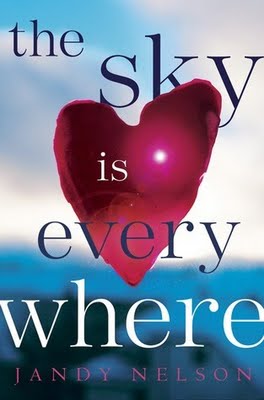
The Sky is Everywhere by Jandy Nelson


Title: The Sky is Everywhere
Author: Jandy Nelson
Publisher: Dial
Release Date: March 9th, 2010
Pages: 277 pages (hardback)
How I Got the Book: Christmas gift.

Seventeen-year-old Lennie Walker, bookworm and band geek, plays second clarinet and spends her time tucked safely and happily in the shadow of her fiery older sister Bailey. But when Bailey dies abruptly, Lennie is catapulted to center stage of her own life--and, despite her nonexistent history with boys, suddenly finds herself struggling to balance two. Toby was Bailey's boyfriend; his grief mirrors Lennie's own. Joe is the new boy in town, a transplant from Paris whose nearly magical grin is matched only by his musical talent. For Lennie, they're the sun and the moon: one boy takes her out of her sorrow, the other comforts her in it. But just like their celestial counterparts, they can't collide without the whole wide world exploding.

Just as much a celebration of love as it is a portrait of loss, Lennie's struggle to sort her own melody out of the noise around her is always honest, often hilarious, and ultimately unforgettable.

Review:

Since her older sister Bailey died at nineteen due to a problem with her heart, Lennie Walker has been at a complete loss. She's always had Bailey there with her, acting as the companion pony to her sister's racehorse. Still drowning in her grief, she is forced to stand on her own and live day-by-day when all she wants is her sister back. This is all happening at the same time as her sexual awakening and the trouble she has with two boys: new student and fellow musical talent Joe Fontaine and Toby Shaw, Bailey's boyfriend and the boy she seeks comfort in.

I have not seen characterization this strong and this wonderful for a while. For once, I felt like I could tell someone what the heroine's personality was if asked! Not only was Lennie a good heroine, she was a realistic one--she's not without her flaws, such as her insecurity and her selfishness in the wake of Bailey's death. Even Bailey, dead for the entirety of the story, had such great characterization and presence that she was alive in a way. This was the same for many of the characters, including Gram, Joe, and Uncle Big. The notes left in books, on branches, and on bathroom walls offer even more insight into the mind of this grief-addled girl.

Of all the times for Lennie to wake up and realize that boys are there and she likes them, it was horrible that it happened right after her sister's death. The overwhelming grief and new sexual desires tangle up inside of her, leading to more than a few problems (can we say Toby?). My word isn't because I have only lost two relatives (one died when I was too young to remember and the other... well, I had a hard time finding it in me to miss and mourn her because of what she did to my family), but The Sky is Everywhere is a stunning portrait of grief. No, not just of grief. Of the the internal struggle that happens when you're trying to move on with your life after someone's death and yet refuse to let them go because you're afraid they'll think badly of you from wherever they are. Everyone hurts, not just Lennie.

I admit, there isn't much of a solid plot to this book. That's why it took me a week to read it when I probably could have done it in three days: I didn't feel like there was anything to keep me reading. Sometime around page 180, something kicked in. Maybe it was that Lennie was forced to stand on her own after all the people she had been leaning on refused to hold her up anymore. Maybe it was that the hints of something more to everything finally got through my thick skull to my brain. Whatever it was, I sat in my chair for two hours and finished reading The Sky is Everywhere. You want plot? Go elsewhere. You want a character-driven novel? Here's your stop.

Despite its wonders, The Sky is Everywhere is not without flaw. My mortal nemesis good friend, the "love rival is a bitch" trope, made an appearance with the help of Rachel, the girl who holds first chair clarinet in Lennie's class. Did Rachel have any use in the story other than to make Lennie feel insecure and make her angst about whether or not Joe's involved with Rachel? Parts of this story, especially the beginning, were very telltelltell instead of showshowshow and constant telling is irritating, to say the least. There were also a few... interesting and unneeded references in there. We don't need to know that Gram doesn't drive, and that moment of "now I know why that king abdicated his throne for love, love is awesome" was a little overdramatic. Not so much bad as it was strange and out-of-nowhere.

Unless the reader lacks a heart, this book will most likely make someone cry at least once. Stories like this are not my typical fare (I prefer romance to remain a subplot, if it has to be there at all, and action), but The Sky is Everywhere was worth the time spent reading it. The novel is never about just grief or just love: it's always about both of them and how they affect everyone in the Walker family, not just Lennie. For once, there is good reason for all the praise this novel has garnered.

4 stars!


What am I reading next?: Steampunk by Ann and Jeff VanderMeer